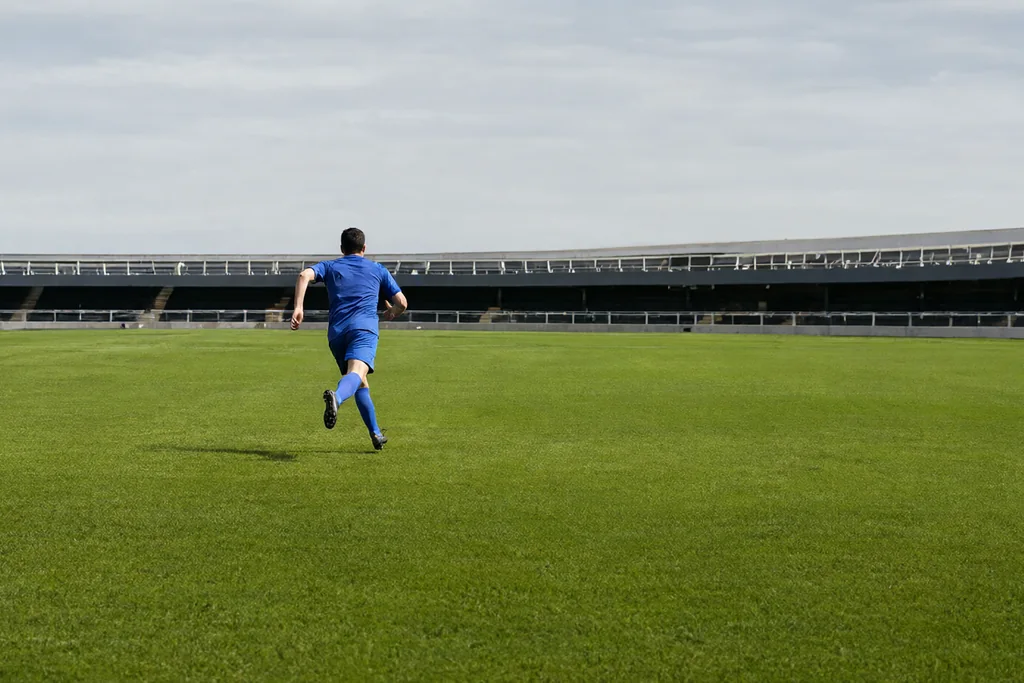
Defensive Midfielder Role: Scouting the Number 6
The defensive midfielder role has quietly split into two jobs that share one position. One asks a player to destroy: screen the back four, win second balls, foul when necessary. The other asks him to conduct: receive from the goalkeeper, beat a press, feed the players ahead of him.
Clubs that treat the position as a single brief end up with a player who does half of what the team needs. Scouting it properly means deciding first which version of the job exists in the side.

The partner question, and the first pass
No screening midfielder works alone. The player beside him decides whether he can push forward to intercept or has to hold his position, and the same defender can look brave or reckless depending on which partner he is given.
That makes the first pass a diagnostic. A number six whose first instinct after winning the ball is a safe square pass is usually a destroyer by training; one who turns and looks forward immediately is a conductor who happens to tackle. Both are useful, and only one of them suits a team that wants to attack within eight seconds of a turnover.
Number 6 role in football: screening comes first
At its base the number 6 role in football is a screening job. The player positions himself between the ball and the centre backs, closes the passing lane into the striker and delays the counter-attack long enough for team-mates to recover their shape. It is a reading task more than a tackling task.
That is why interception counts matter more than tackle counts for this version of the role. A player who intercepts is usually in the right place before the pass is played, while a player who tackles frequently may be arriving late and often.
Discipline is the hidden requirement. A screening midfielder who dives into challenges gives away free kicks in the most dangerous area of the pitch, and one booking away from suspension he becomes a different, much less effective player.
Holding midfielder role: build-up duties
The modern holding midfielder role adds a second responsibility: being the first option out of defence. He receives from the goalkeeper or centre backs with opponents pressing, and whatever he does next sets the tempo of the attack.
Two attributes decide how well he does it. The first is body shape before receiving, which determines whether his first touch takes him forward or back. The second is the ability to play through a press with a pass of ten to twenty metres rather than a safe square ball.
If a club's build-up depends on this, the profile should say so explicitly. Signing a destroyer to conduct, or a conductor to screen, is a common and expensive mistake.
- Screen first: interception, positional discipline, aerial cover in front of the box.
- Conduct first: receiving under pressure, line-breaking passes, tempo control.
- Both: rare, expensive, and usually the first name on a team sheet.
Number 6 role in football: press resistance
Press resistance in the number 6 role in football is measured in two ways: how often the player loses the ball in his own half, and how often he is forced into a pass he did not want to make. The second is invisible in most datasets and obvious on video.
Clips should show him receiving with an opponent within two metres, in both halves of the pitch. A midfielder who is calm in the opposition half and panicky in his own is a specific and predictable kind of risk, and the profile has to name it.
Holding midfielder role: the two types
The destroyer and the conductor are easy to describe and rarely found in pure form. Most players lean one way, and the scouting task is to work out how far the lean goes and whether the coach can live with the rest.
| Dimension | Destroyer | Conductor |
|---|---|---|
| Primary action | Interception and second ball | Receiving and progression |
| Positioning | Just ahead of the centre backs | Dropping between the centre backs |
| Key metric | Interceptions per 90 | Progressive passes per 90 |
| Failure mode | Bookings and lost duels | Turnovers in his own half |
| Best fit | Transition and low-block sides | Possession and high-press sides |
What to watch in a live viewing
Two things are almost impossible to judge on a clip package. The first is how the player behaves when his team loses the ball and the counter begins: does he sprint towards his own goal immediately, or does he appeal and then jog. The second is his communication, because a screening midfielder is the player who organises everyone else's positioning.
Both are visible from one viewing at the ground, and both are routinely omitted from written reports. A scout who logs them produces a document that a coach can actually use when deciding whether to trust a new signing in a difficult away match.
Where the role meets the metrics
The statistics for this position are unusually well developed, which makes the screening stage easy and the judgement stage no easier at all. Reading interception volume and progression together identifies the two types quickly, and a viewing then decides which one the team needs.
Our breakdown of progressive passes per 90 covers the progression side, and the more advanced possession value measures are set out in the piece on football performance metrics. The final judgement still goes into a standard midfield profile and a written scout report.