
Video Scouting vs Live Scouting: How Clubs Split It

Video scouting has quietly become the default first pass in professional recruitment, and live scouting has become the second. The order matters, because the two methods answer different questions: video tells you what happened, and a live viewing tells you what the player is like when nothing is happening.
The split is also a budget decision. A department with four scouts and three hundred fixtures to cover cannot send people everywhere, so it filters with video and spends travel on the shortlist.
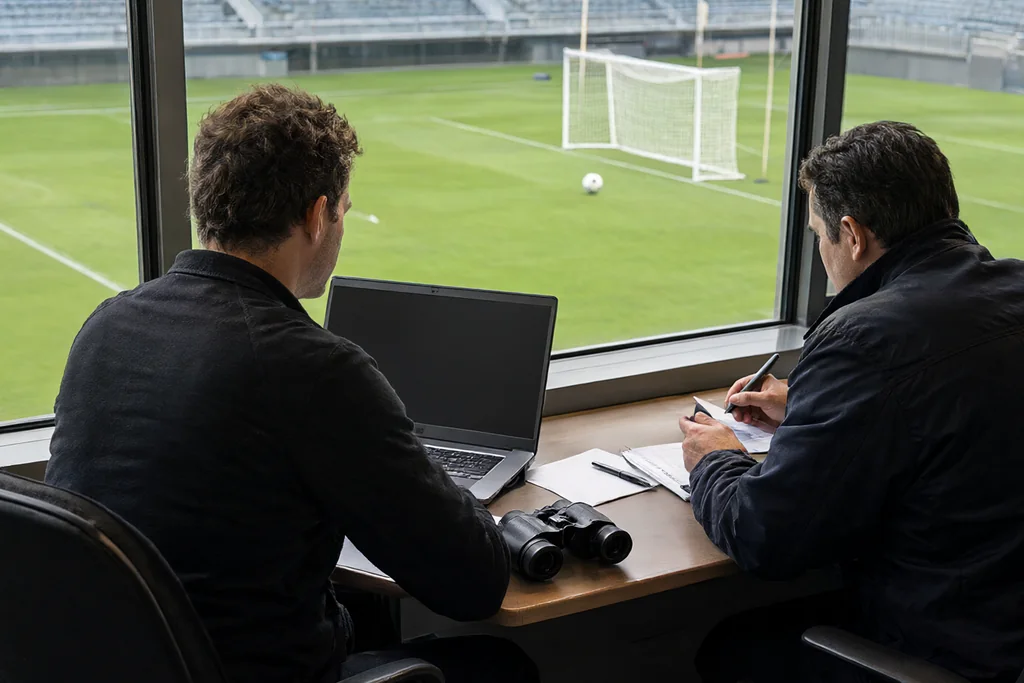
What a viewing costs, and why it is still worth it
A live viewing costs a day of travel, a ticket and the time of the scout who could have covered two video packages instead. Departments that measure only volume will always under-invest in it, which is why the honest justification is the cost of a wrong signing rather than the cost of a trip.
The useful compromise is to spend viewings on decision points. Watch a player live before the fee is agreed rather than eight times during the season, and use video for every stage before that. The same discipline applies to a second opinion: send one different scout to one fixture rather than three scouts to the same one.
What live scouting sees that a clip never will
The core argument for live scouting is off-camera behaviour. A broadcast feed follows the ball, so a striker's movement is invisible whenever play is on the far side of the pitch. At the ground the same player is on screen the whole time, and his discipline in those minutes is on display.
Live viewing also captures things no clip package carries: how the player talks to team-mates after a mistake, whether he drifts out of position when his team is two goals down, and whether his body language changes when the bench signals a substitution.
Football scouting budgets and the live-to-video split
Football scouting departments usually settle on a rough ratio, and the common shape is a wide video filter followed by a narrow live shortlist. Video covers volume; live viewing covers depth. Spending travel on the first pass wastes money, and spending only video on the last pass wastes judgement.
The ratio moves with the market. A club shopping in leagues it already knows can lean on video, because the standard of opposition is familiar. A club shopping abroad leans on live viewings, because video packages rarely show what a league's bottom half is really like.
Live scouting checklists: what to log in real time
A live scouting checklist should be short enough to use at the ground. Positional discipline, scanning, pressing triggers, reaction to transition and contact behaviour are the entries that survive after the notes are written up, because the clips cannot be rewound.
- Off ball: where does he stand when his team has possession on the far side.
- Transitions: first three seconds after losing the ball, and after winning it.
- Contacts: how he reacts to a heavy challenge and to a team-mate's error.
- Shape: does he hold the structure when his side is chasing a goal.
Video scouting workflow: from clip to report
On video the workflow is repeatable and cheap. Clips are tagged by action type, then compiled into a package that shows a defender's aerial duels, a midfielder's line-breaking passes or a forward's runs into the channel. The scout then watches the package and the full match, in that order.
The risk is compression. A twenty-clip package on a centre back can make any competent player look commanding, because the negative moments — the slow recovery, the ball watched instead of cleared — are usually left out. Departments that trust video alone should at least audit what the tagging process is filtering.
| Question | Video | Live |
|---|---|---|
| Volume, fixtures per week | High, no travel | Low, three or four per week |
| Off-ball movement | Poor, camera follows the ball | Strong, whole pitch visible |
| Body language and discipline | Rarely captured | Directly observed |
| Cost per player assessed | Low | High |
| Rewind and re-check | Immediate | Impossible |
Football scouting and the off-ball player
The players most easily misjudged on video are the ones whose value is positional. A defensive midfielder who barely touches the ball in a highlights package may be the reason his team is never countered, and that only becomes visible in the wide angle of a live viewing.
Forwards suffer the opposite problem. A poacher's whole game is two clips, and a clip package makes him look more complete than he is, which is why the tally behind the goals needs checking through advanced football metrics before any conclusion is drawn.
Merging the two into one recommendation
Neither method owns the verdict. The video pass fills the template and the live viewing decides whether the department believes it, and both feed the same scout report that the recruitment meeting reads.
Where the two disagree, that disagreement is the most valuable output of the process. A player who looks excellent on video and anonymous in the stadium usually has an athletic or temperament question, and it is far cheaper to find that out before the transfer target reaches the negotiating table.